Hydro jetting in Cooper City that clears the whole pipe
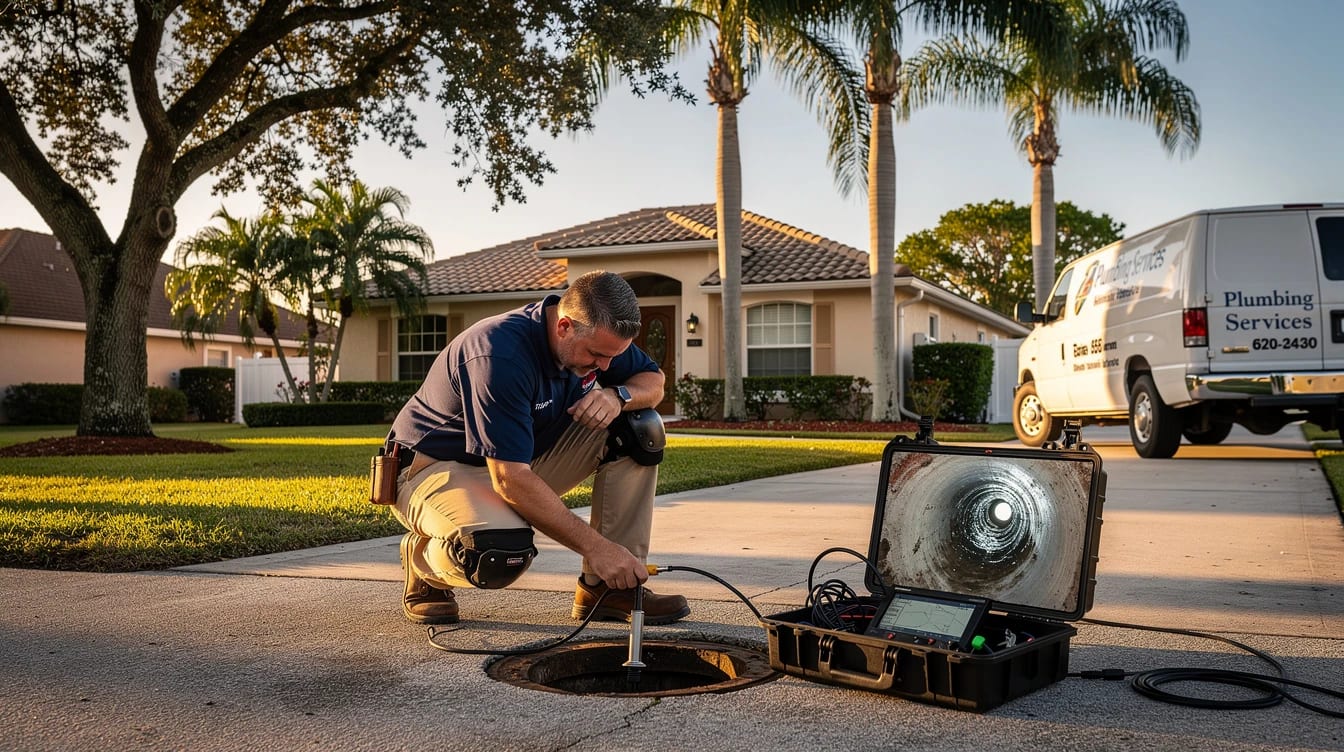
A cable snake bores a tunnel through the center of a clog and calls it done, and the grease film, root hairs and mineral crust stay stuck to the walls. Our truck-mounted jetter drives water at up to 4000 PSI around the full inside surface of the pipe, and the camera runs before and after so you watch the buildup disappear.
Why the same drain keeps clogging
A cable is the right tool for a hair clog or a single stuck object, and we use one plenty. But when a line backs up over and over, the pipe wall itself is coated with something a hook or auger can't touch. Here's how to tell which situation you're in and what actually resolves it.
Hardened grease in kitchen lines
Cooking oil and fat cool inside the pipe and set like wax on the walls. A cable pokes a channel through the middle for a week or two before the grease closes back in. Jetting scrapes the coating off entirely.
Roots working through a seam
Tree roots find moisture at a pipe joint and grow inward until they choke the flow. A rotating jetting nozzle cuts the root mass back and washes the fragments out, buying real time while we check the joint itself.
Scale choking down the diameter
Older cast iron and hard-water minerals build up a rough crust that shrinks the usable opening year after year. Jetting strips the scale back to bare metal and gives you the pipe's true diameter again.
Backups that follow a pattern
Restaurants and multi-unit buildings that back up on a schedule aren't unlucky, they're overdue for maintenance. A jetting interval keeps grease traps and branch lines open before the next rush hits.
Sediment sitting in a main line
Old soap film and settled solids collect along the bottom of a main and snag anything that comes after them. A full jetting pass sweeps the accumulated sediment out toward the sewer connection.
Cable cleared it, but not for long
If a stubborn drain clog reopens days after a cable pass, the wall coating is still there. Jetting is the step that goes after the coating itself instead of just the blockage in the middle.
Six steps, start to finish
Camera the pipe first
We push a camera through the line to see what's actually blocking it and confirm the pipe can take high pressure. We never jet a line we haven't looked at first.
Choose the right nozzle
Based on the footage we fit the truck-mounted unit with the correct head, whether that's a root-cutting nozzle, a grease-stripping tip, or a penetrating nozzle for scale, and feed the hose in through the nearest cleanout.
Wash the wall clean
Water up to 4000 PSI strips the coating from the pipe wall while forward jets pull loosened material downstream toward the sewer connection. This is the step a cable simply can't perform.
Confirm it on camera
The camera goes back down the same line so you can see the bare pipe wall for yourself, real proof the job is finished, not a guess based on how fast water is draining.
Tell you what we found
If the after-footage shows a crack, a sag, or a separated joint, we explain your sewer line repair options plainly, no pressure to sign anything on the spot. Every job leaves with a written warranty.
Suggest a maintenance rhythm
Kitchens and multi-unit buildings that jet on a set schedule almost never see a surprise backup. We'll size the interval to your property instead of guessing.
Two tools, and we'll tell you which one you need
A cable machine is quick, cheap, and perfectly fine for a single fixture that just picked up a hair clog. A standard drain cleaning call usually covers that. But grease, roots, and scale live on the pipe wall, and a cable never touches them.
We camera the line first to decide which tool actually solves your problem, then jet the whole run if that's what it needs, so you're not calling us back about the same drain next month.
Book a camera inspection(754) 304-0006
A number you can see, not guess at
The pre-jetting camera footage tells us exactly what's blocking your line, and the after footage tells you the job worked. Here's what actually moves the price we quote before any equipment turns on.
Pipe diameter
A narrow branch line moves faster than a wide main run.
What's clogging it
Grease, roots, and hardened scale each call for a different nozzle and time on site.
How we get the hose in
A ground-level cleanout is simple. A rooftop vent stack adds setup time.
Distance to the sewer tap
Longer runs need more hose out and more time working it.
Home or commercial
A residential branch is a different job than a grease-loaded restaurant main.
Age and material
Older cast iron common in Cooper City and neighboring Broward neighborhoods needs a more careful pressure setting.
The rest of what the same trucks carry
Drain cleaning
Kitchen sinks, tub drains and main lines cleared with cable or hydro-jet, whichever the blockage actually needs.
See drain cleaning →Clogged drain repair
A toilet that won't quit rising, a shower filling up around your ankles, or a kitchen sink holding a day's worth of dishwater, cleared today.
See clogged drain repair →Sewer line repair
A root, an offset joint, a low spot or worn-out cast iron: we run a camera down the line before we ever pick up a shovel.
See sewer line repair →Trenchless sewer repair
A failing sewer lateral relined from the inside, with your lawn, patio and driveway pavers left exactly where they are.
See trenchless repair →Cast iron pipe replacement
Original cast iron that has scaled shut or split under the slab, pulled and replaced with PVC that outlasts the house.
See cast iron work →Hydro jetting, explained
What actually makes jetting different from a cable snake?
A cable spins a cutting head through the middle of a clog and pulls it back, which restores flow immediately but leaves the grease, root fibers, or mineral crust stuck to the pipe wall. Hydro jetting fires water at up to 4000 PSI through a rotating nozzle that reaches every side of the pipe interior, so the coating causing the clog actually leaves the pipe instead of getting pushed downstream. That's the difference between a temporary opening and a pipe that's genuinely clean.
Could jetting damage an older pipe?
It can, if it's done blind. That's the entire reason we camera every line before we touch it: to see whether the pipe is sound enough for high pressure and to pick a setting that fits its age and material. Healthy PVC, copper, and reasonably intact cast iron all handle jetting well. If the inspection turns up a pipe that's already fractured or badly deteriorated, we won't jet it, we'll show you the footage and talk through cast iron pipe replacement instead. Skipping that inspection step just isn't how we operate.
My restaurant's grease trap line keeps backing up. Is jetting worth it?
Almost certainly. Commercial kitchens push far more grease and oil through their lines than any residence, and it hardens onto the pipe wall in a way a snake never fully clears. A single backup during dinner service can mean lost tickets and a potential health inspection issue. Jetting strips the built-up grease and we can set a maintenance interval, quarterly or twice a year depending on volume, so it never gets to that point. Most of our commercial customers save money on the schedule versus paying for emergency calls.
Will jetting get rid of roots in my sewer line for good?
A root-cutting nozzle clears the roots that have grown in and restores flow, but it doesn't seal the crack or open joint that let them in to begin with, so roots can return over time at that same spot. Once we've jetted the line, the camera shows exactly where the intrusion happened. If it's a small, occasional nuisance, an annual or twice-yearly jetting visit can manage it. If the entry point is significant, we'll walk you through trenchless sewer repair so the opening gets sealed instead of just cleared out again and again.
How long should I expect a jetting appointment to take?
A typical residential branch line, camera passes included, is often wrapped up within an hour or two. A long commercial main with heavy grease buildup takes more time, and tricky access like a rooftop vent stack adds to that. Once we've cameraed the line and know what we're dealing with, we give you a realistic time window before starting. We'd rather do the job right with both inspection passes than rush it and hand you a false sense of clean. Call us if you want to talk through your specific situation first.
Stop treating the symptom. Clean the pipe.
If a line keeps backing up no matter how many times it's been snaked, hydro jetting goes after the buildup on the wall, and we camera it before and after so you see the result yourself. Insured and backed by a written warranty on parts and labor, serving Cooper City and the surrounding Broward, Miami-Dade, and Palm Beach communities.
Call now · 24/7(754) 304-0006Licensed & insured · FL CFC1433655 · Written warranty on parts and labor · Sewage backing up right now? Skip the form and call.